Launch offer — valid today only

📄 Digital book in PDF · read it on your phone or print it

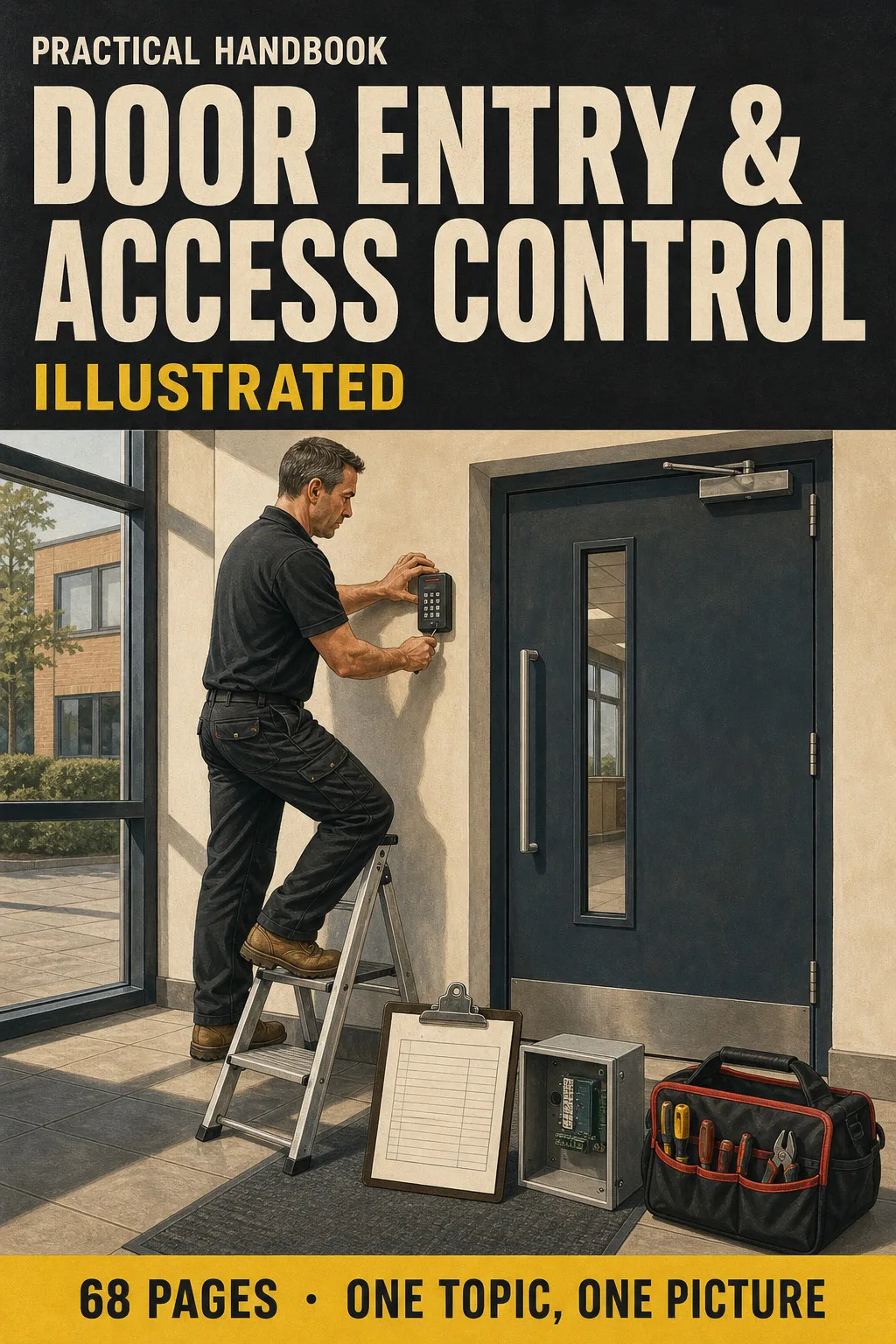
Door Entry, Access Control and UK Escape Rules in Drawings Wire Any Door in 8 Steps, Same Order Every Time

Maglocks and strikes, fail-safe vs fail-secure, sizing the PSU, Wiegand and OSDP, door entry panels, wiring a door step by step, escape routes and the fire alarm link, commissioning and fault finding. Every topic has its own page: the drawing first, then what you need to remember. 68 illustrated pages.

GET THE ILLUSTRATED DOOR BOOK

🔒 Secure checkout · PDF by email · 30-day guarantee

Every topic, its own pageEach lock, terminal and test drawn, with the explanation alongside
68 illustrated pages9 parts, from one door's seven parts to the pre-handover checklist
Up-to-date sourcesBS 7671, BS 7273-4 and BS EN 179 / BS EN 1125
PDF by emailFormat

Look Inside the Book

Every page has one big drawing and a box with the terminals, numbers and steps you need to know:

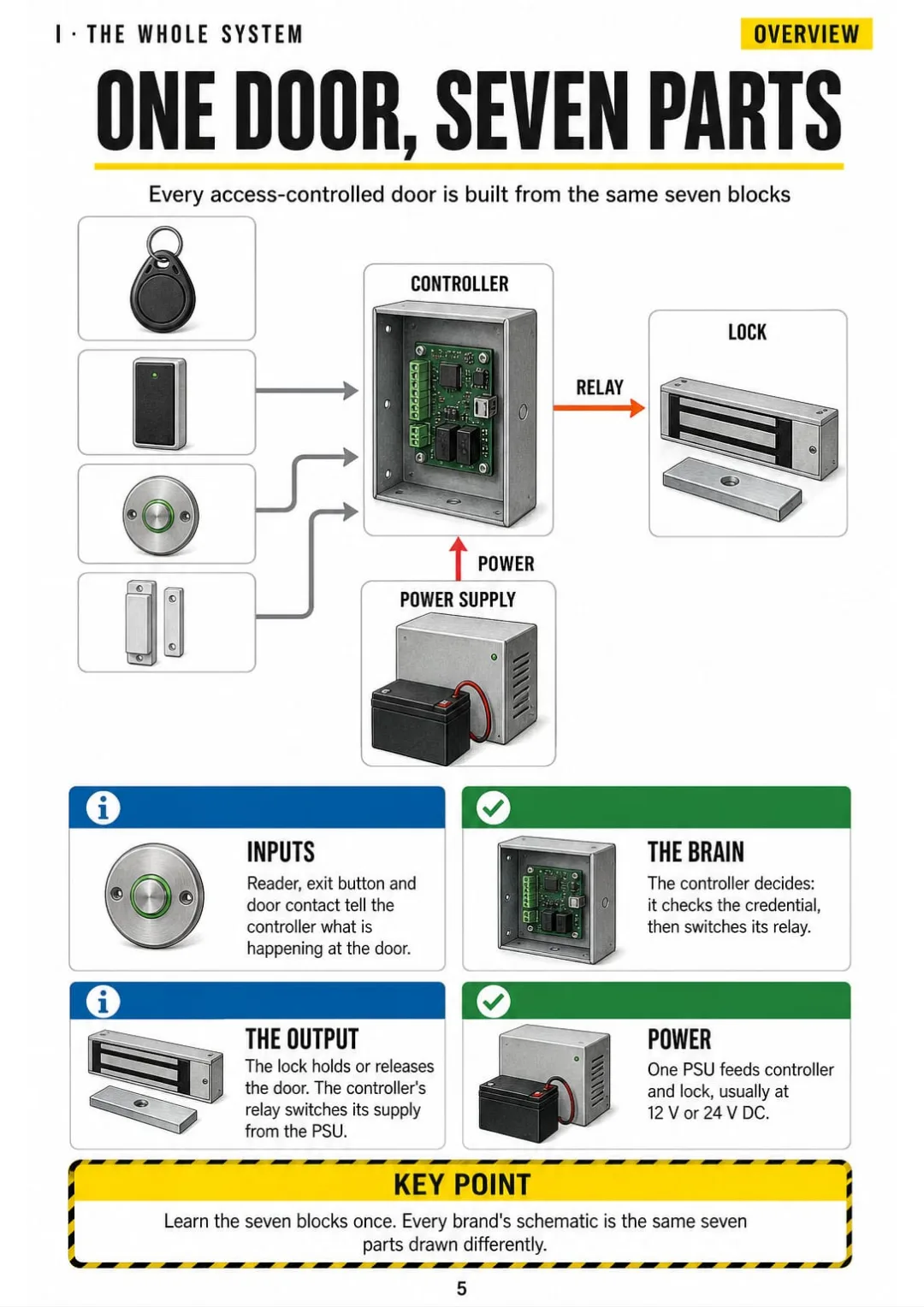
Credential, reader, controller, lock, PSU, exit button, door contact: one block diagram.
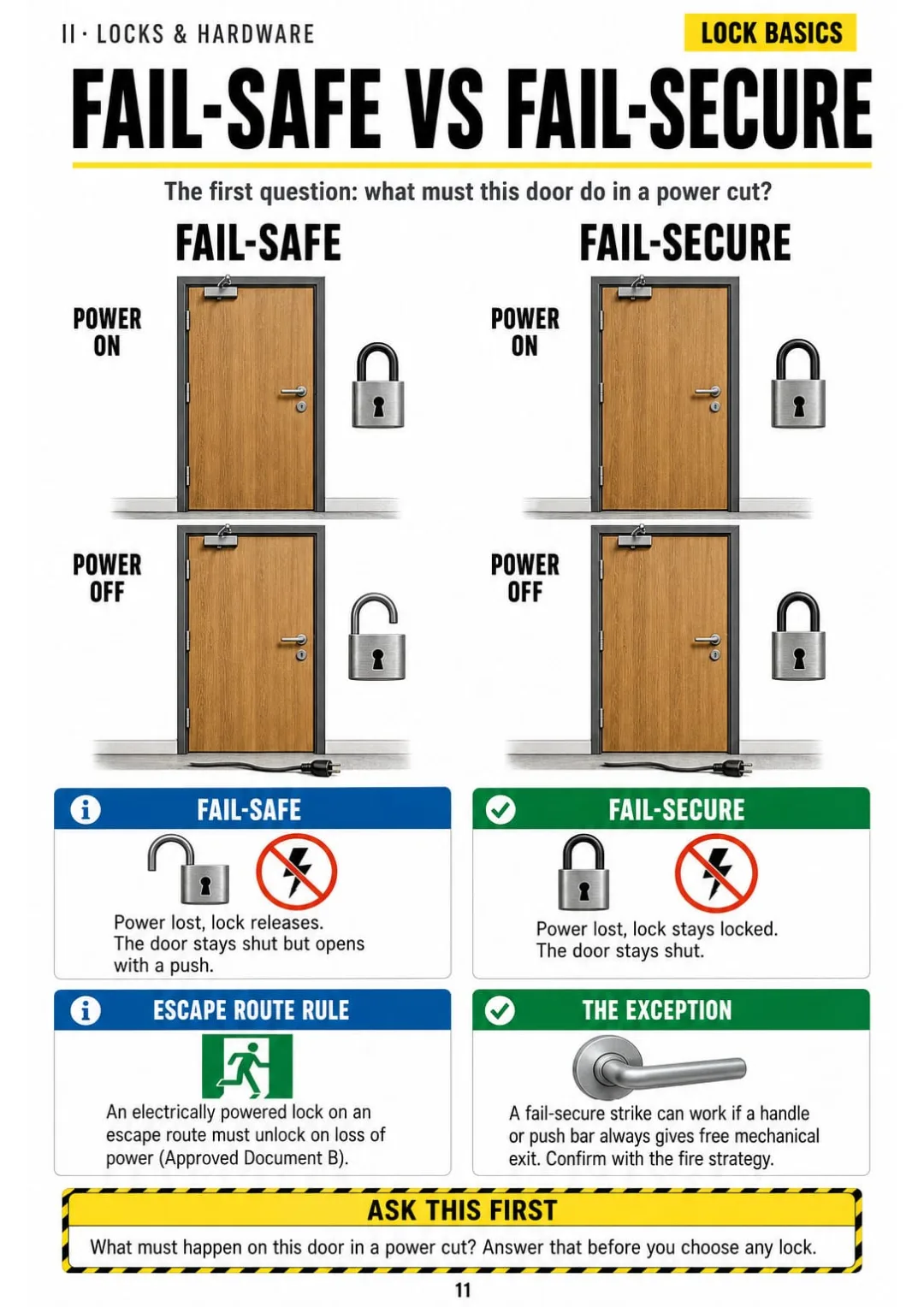
Same door, power on and off: fail-safe releases, fail-secure holds.
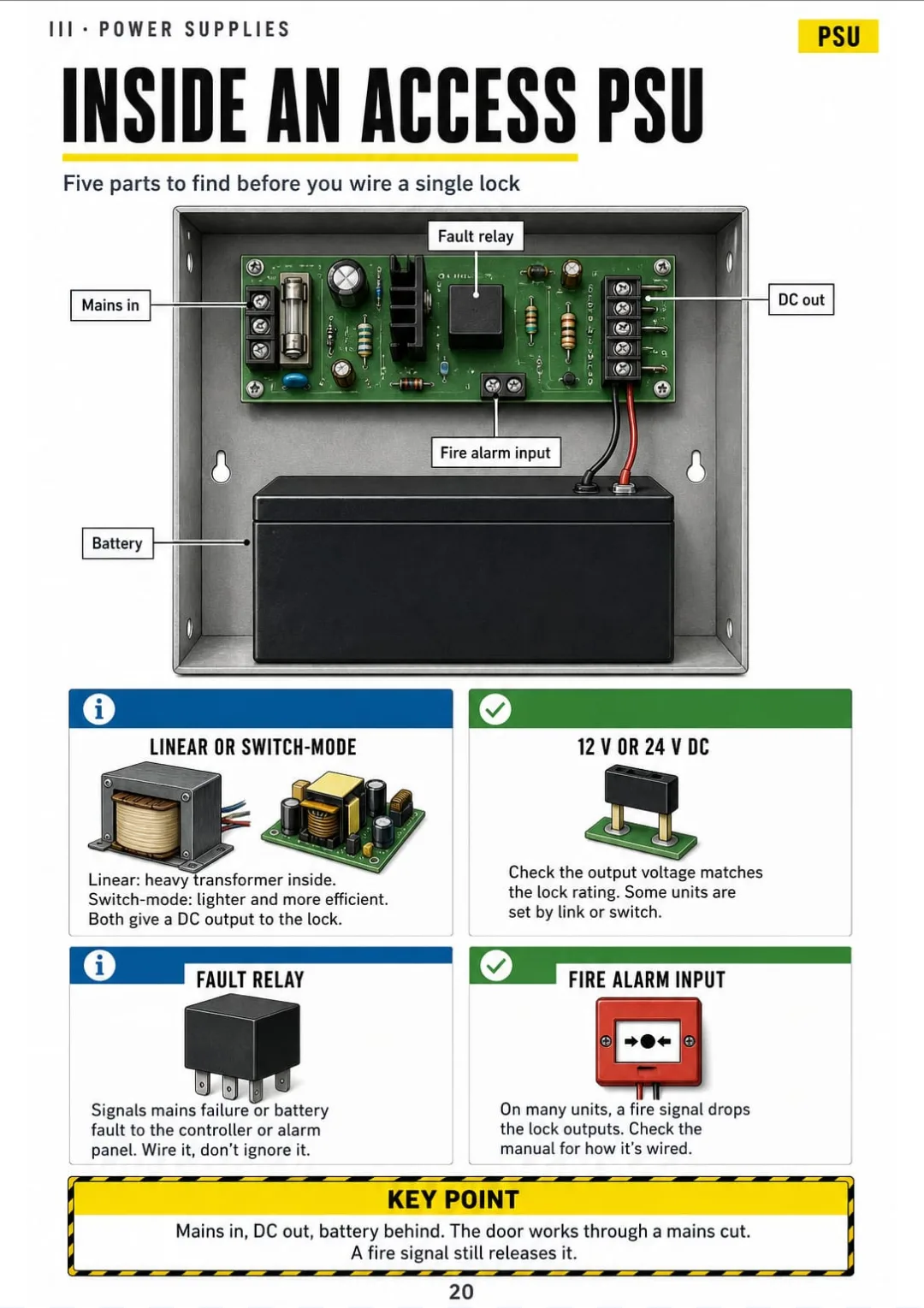
Mains input, fused outputs, battery, charger and fault relay, labelled on one open PSU.
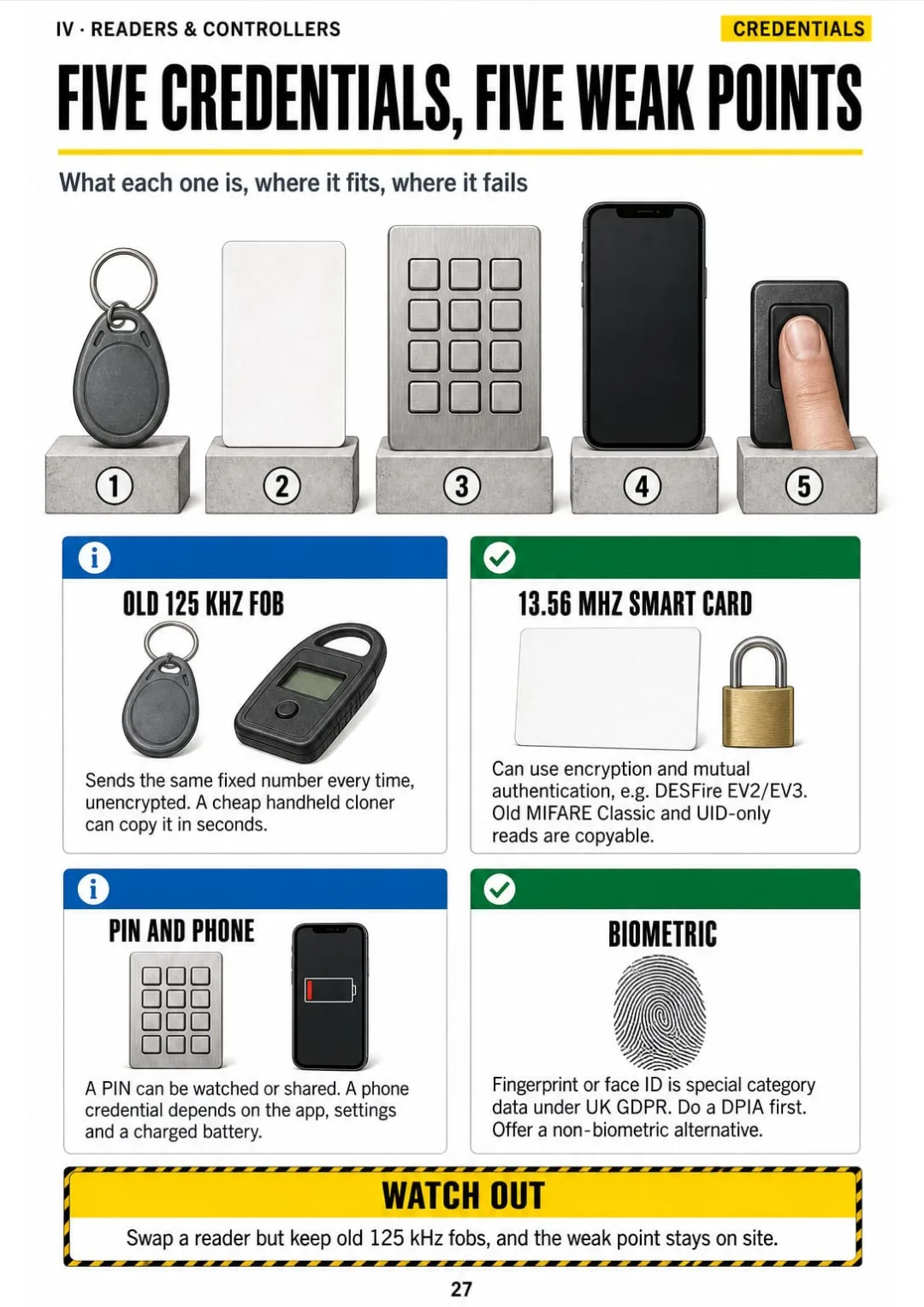
Fob, card, PIN, phone, biometric: 125 kHz vs 13.56 MHz and each weak point
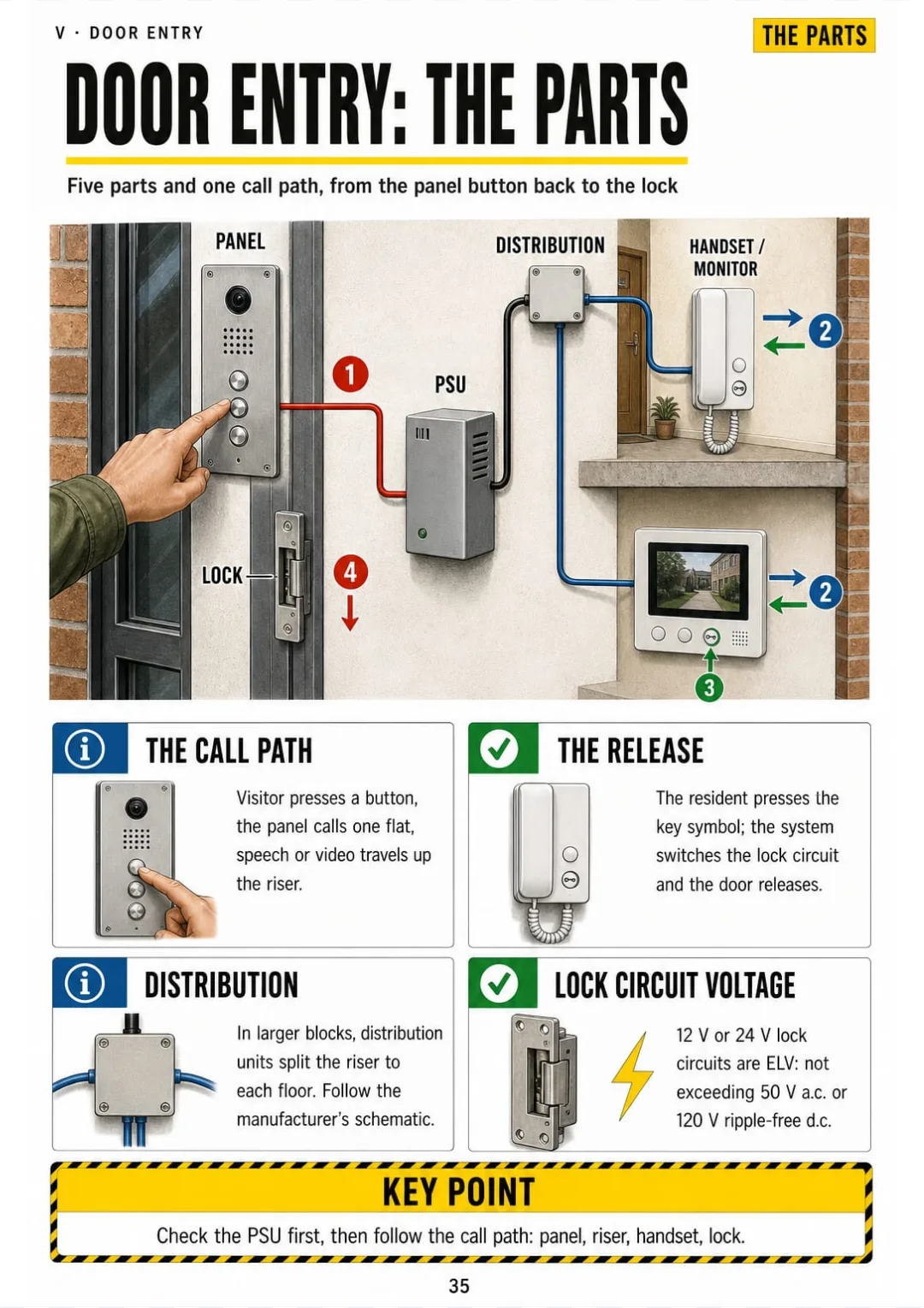
Panel, PSU, handset, monitor and lock: the call path in four numbered steps
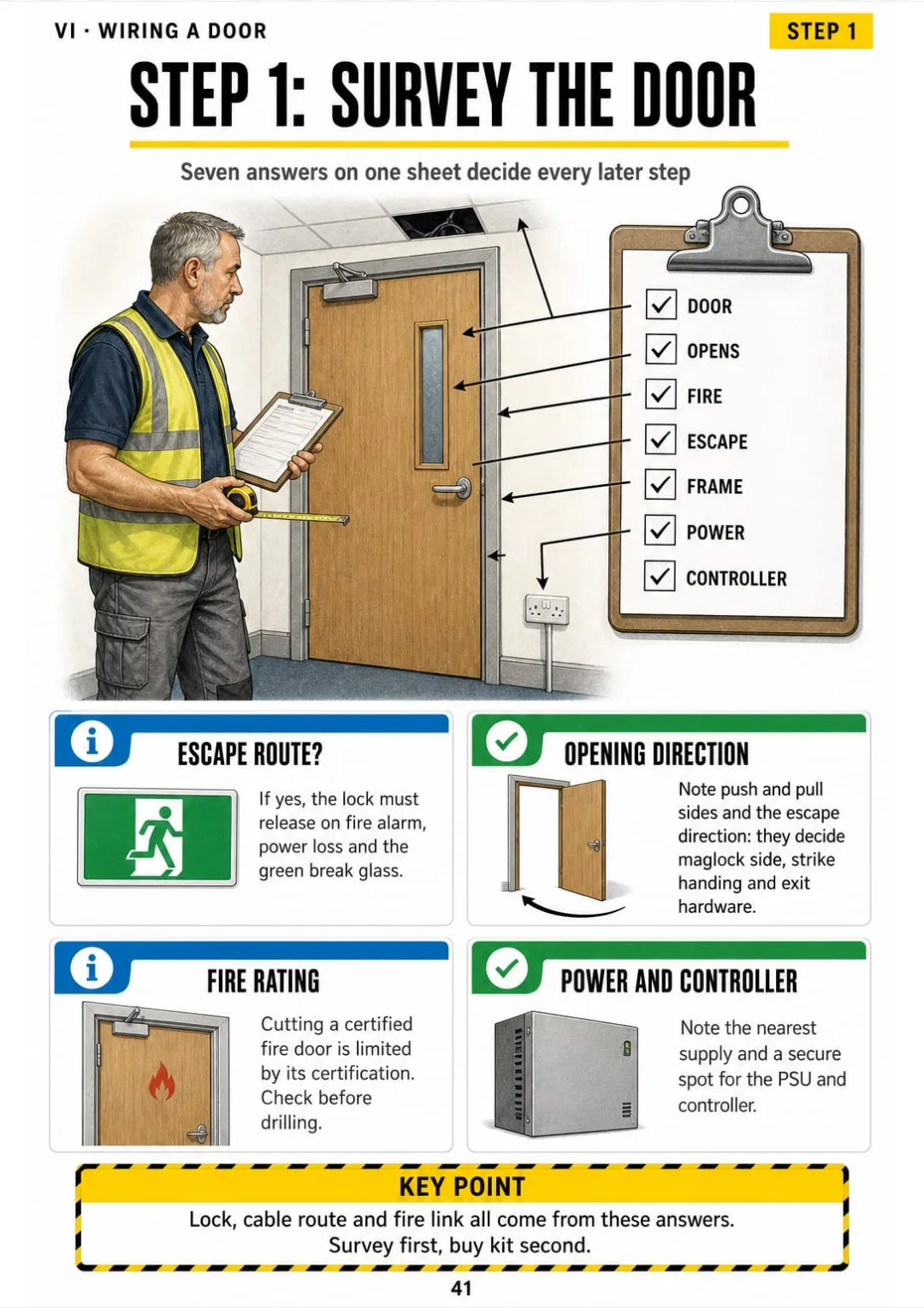
Door survey: material, swing, fire rating, escape route, frame, power, controller
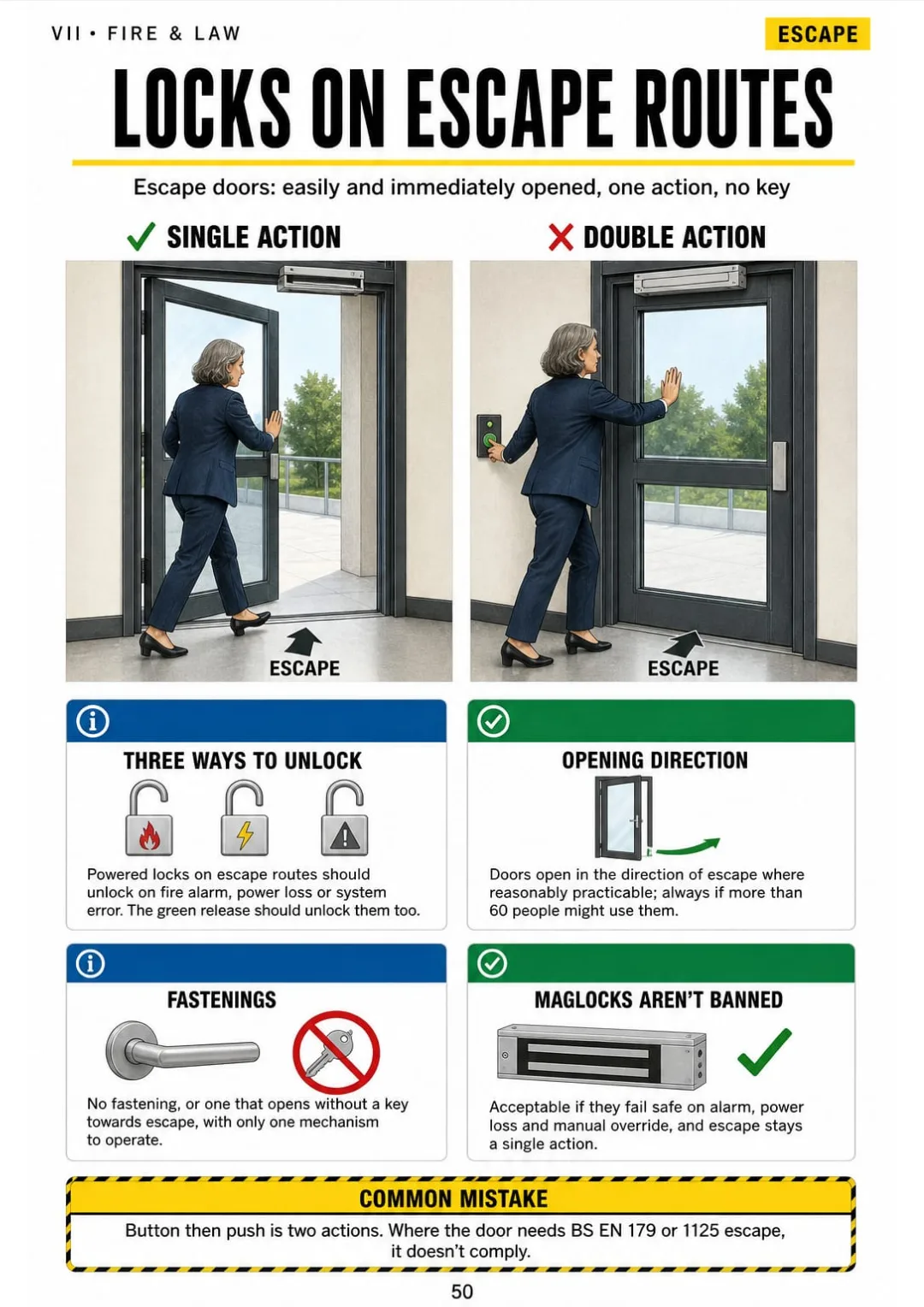
Maglock plus press-to-exit then push = two actions: not compliant where BS EN 179/1125 escape is required.
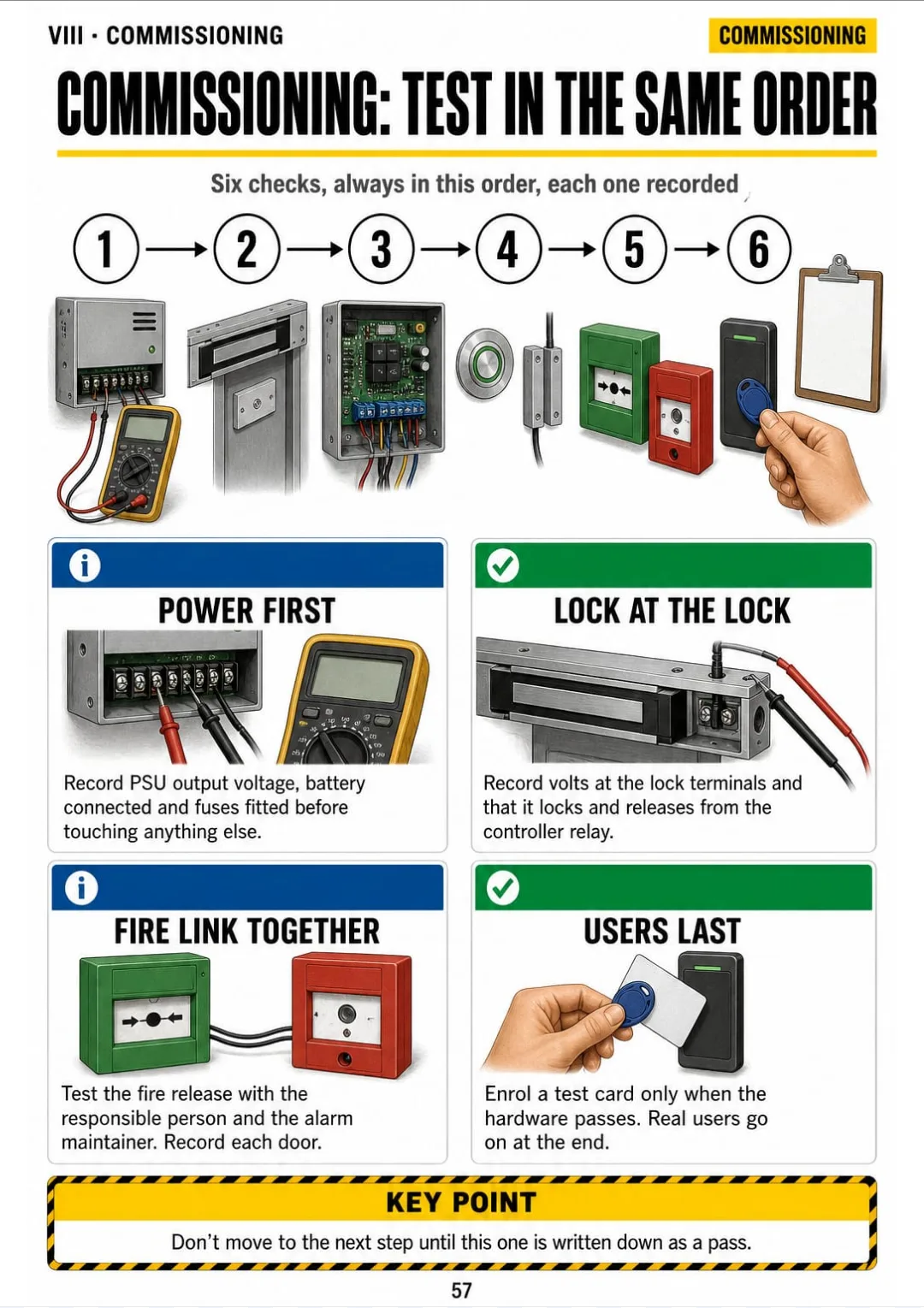
Power, lock, controller, inputs, fire link, users: six checks, always in that order.

Swipe to see more →

These are real pages from the book. The table of contents is the full one: 9 parts and 64 topics.

The Problem Isn't You. It's How It Was Explained.

You're up a ladder with the lid off an access power supply in a block of flats. The lock's dead, and the customer wants to know why.

Mains in, two fuses, a battery lead, a charger board, a relay marked FAULT. The manual covers it in four pages of paragraphs, and none of them shows you where to put the meter first.

Mains input, fused outputs, battery, charger and fault relay, labelled on one open PSU.

In the book, that PSU is one page: the box drawn open, with mains input, fused outputs, battery, charger and fault relay each labelled with an arrow. You can see which side is mains and which side feeds the lock.

The same goes for fail-safe vs fail-secure, adding up the load, voltage drop on the lock run, battery standby and the fault-finding order: each one has its own page.

Next time the lid comes off, you know what you're looking at and you check it without reaching for the manual.

COMPARE FOR YOURSELF

Same Topic, Two Ways to Learn It

THIS
  • The manual: line after line
  • Lock modes explained in words alone
  • You turn up on site still unsure
A fail-safe locking device is one which, upon removal or interruption of its electrical supply, reverts to an unlocked condition, thereby permitting egress; electromagnetic locks are inherently of this type, as their holding force is dependent upon continuous energisation of the coil. Conversely, a fail-secure device maintains its locked condition in the absence of power and requires energisation to effect release, as is typical of electric strike configurations. Selection between the two shall have regard to the security requirement, the escape provisions and the fire strategy of the premises.
FOR THIS
  • Fail-safe and fail-secure in one drawing
  • Power on and power off in a box
  • You see it and you get it
Same door, power on and off: fail-safe releases, fail-secure holds.
CONTENTS

Take a Look at the 9 Parts and 64 Topics

The whole system, locks and door hardware, power supplies, readers and controllers, door entry, wiring a door start to finish, fire safety and the law, commissioning and fault finding, and quick revision: 68 pages, all illustrated.

IThe Whole System at a Glance · pp. 5-10
  1. One Door, Seven Parts
  2. Door Entry vs Access Control
  3. Standalone, Networked or Cloud
  4. The Signal Path: In, Decide, Out
  5. Low Voltage, Mains and Where They Meet
  6. Reading a Manufacturer's Schematic
IILocks and Door Hardware · pp. 11-19
  1. Fail-Safe vs Fail-Secure
  2. The Maglock
  3. Maglock Mounting: Brackets and Alignment
  4. The Electric Strike (Release)
  5. Shear Locks and Electric Bolts
  6. Motor Locks and Electric Mortice Locks
  7. Exit Hardware: Push Bars and Lever Handles
  8. Door Closers and Why the Door Must Close
  9. Choosing the Lock for the Door
IIIPower Supplies · pp. 20-26
  1. Inside an Access PSU
  2. Adding Up the Load
  3. 12 V or 24 V: Same Lock, Half the Current
  4. Voltage Drop on the Lock Run
  5. Battery Standby: How Many Hours
  6. Back EMF: Diode and Varistor
  7. Fused Outputs and Supply Separation
IVReaders, Credentials and Controllers · pp. 27-34
  1. Credentials: Fob, Card, PIN, Phone, Biometric
  2. Wiegand: D0, D1 and Its Limits
  3. OSDP over RS-485
  4. Reader Positioning
  5. The Door Controller
  6. Relay Contacts: NO, NC and COM
  7. Door Contact and Request-to-Exit
  8. Access Levels, Schedules and Door Modes
VDoor Entry and Intercoms · pp. 35-40
  1. Audio and Video Door Entry: the Parts
  2. Multi-Wire vs 2-Wire Systems
  3. IP and SIP Door Entry
  4. GSM and 4G Intercoms
  5. Trade Buttons and Postal Access
  6. Upgrading an Old Door Entry System
VIWiring a Door Start to Finish · pp. 41-49
  1. Step 1: Survey the Door
  2. Step 2: Plan the Cable Runs
  3. Step 3: Get Power and Data into the Door
  4. Segregation from Mains Cables
  5. Step 4: Fit and Wire the Lock
  6. Step 5: Fit and Wire the Reader
  7. Step 6: Exit Button and Door Contact
  8. Step 7: The Green Break Glass
  9. Step 8: Label, Tidy and Record
VIIFire Safety, Escape and the Law · pp. 50-56
  1. Locks on Escape Routes
  2. Linking to the Fire Alarm: BS 7273-4
  3. Fire Doors and What You Can Fit
  4. Accessible Doors
  5. Mains Work: What BS 7671 Covers
  6. User Data and UK GDPR
  7. Security Grading: BS EN 60839-11-1
VIIICommissioning and Fault Finding · pp. 57-64
  1. Commissioning: Test in the Same Order
  2. Testing the Lock and the Fire Release
  3. Insulation Testing Without Damaging the Kit
  4. Fault-Finding Order: Power, Lock, Controller, Input
  5. Door Won't Release
  6. Door Won't Lock or Hold
  7. Reader Dead or Card Not Reading
  8. Handover to the Customer
IXRevision and Quick Checks · pp. 65-68
  1. Most Frequent Wiring Mistakes
  2. Most Frequent Survey and Hardware Mistakes
  3. The Door on One Page
  4. Pre-Handover Checklist

One Page, One Topic, All Clear

Think of it this way:

It's Monday morning at a school. The head wants the side door on fobs, it's on an escape route, and you have to decide the lock before you order a thing.

You open the book at Locks on Escape Routes and see the door drawn with a maglock, a press-to-exit button and a push bar, and why two actions aren't the same as one.

Panel, PSU, handset, monitor and lock: the call path in four numbered steps

The same with choosing the lock for the door, sizing the PSU, Wiegand vs OSDP, the fire alarm link and commissioning: each one on its own page.

Door Entry & Access Control Illustrated is 9 parts and 64 topics, all drawn, with the most frequent mistakes, the whole door on one page and a pre-handover checklist at the end.

What you see drawn, you don't have to memorize.

What's Inside Door Entry & Access Control Illustrated:

Ipp. 5-10

The Whole System at a Glance

The seven parts of a door, door entry vs access control, standalone, networked or cloud, the signal path, low voltage vs mains and how to read a maker's schematic.

IIpp. 11-19

Locks and Door Hardware

Fail-safe vs fail-secure, maglocks and their brackets, electric strikes, shear locks and bolts, motor locks, exit hardware, door closers and choosing the lock for the door.

IIIpp. 20-26

Power Supplies

What's inside an access PSU, adding up the load, 12 V vs 24 V, voltage drop on the lock run, battery standby, back EMF and fused outputs.

IVpp. 27-34

Readers, Credentials and Controllers

Credentials, Wiegand and OSDP, reader positioning, the door controller, NO, NC and COM contacts, door contact and request-to-exit, access levels and door modes.

Vpp. 35-40

Door Entry and Intercoms

Audio and video door entry, multi-wire vs 2-wire, IP and SIP, GSM and 4G intercoms, trade buttons and upgrading an old system.

VIpp. 41-49

Wiring a Door Start to Finish

One door wired in 8 steps: survey, cable runs for power and data, segregation from mains, lock, reader, exit button and door contact, green break glass, labels and records.

VIIpp. 50-56

Fire Safety, Escape and the Law

Locks on escape routes, the fire alarm link under BS 7273-4, fire doors, accessible doors, what BS 7671 covers, user data under UK GDPR and security grading.

VIIIpp. 57-64

Commissioning and Fault Finding

Commissioning in a fixed order, testing the lock and the fire release, insulation testing without damaging the kit, the fault-finding order, three typical call-outs and handover.

IXpp. 65-68

Revision and Quick Checks

The most frequent wiring, survey and hardware mistakes, the whole door on one page and a pre-handover checklist.

At the end of the book: Most frequent mistakes, the whole door on one page and a pre-handover checklist.
Plus: 2 Free Books

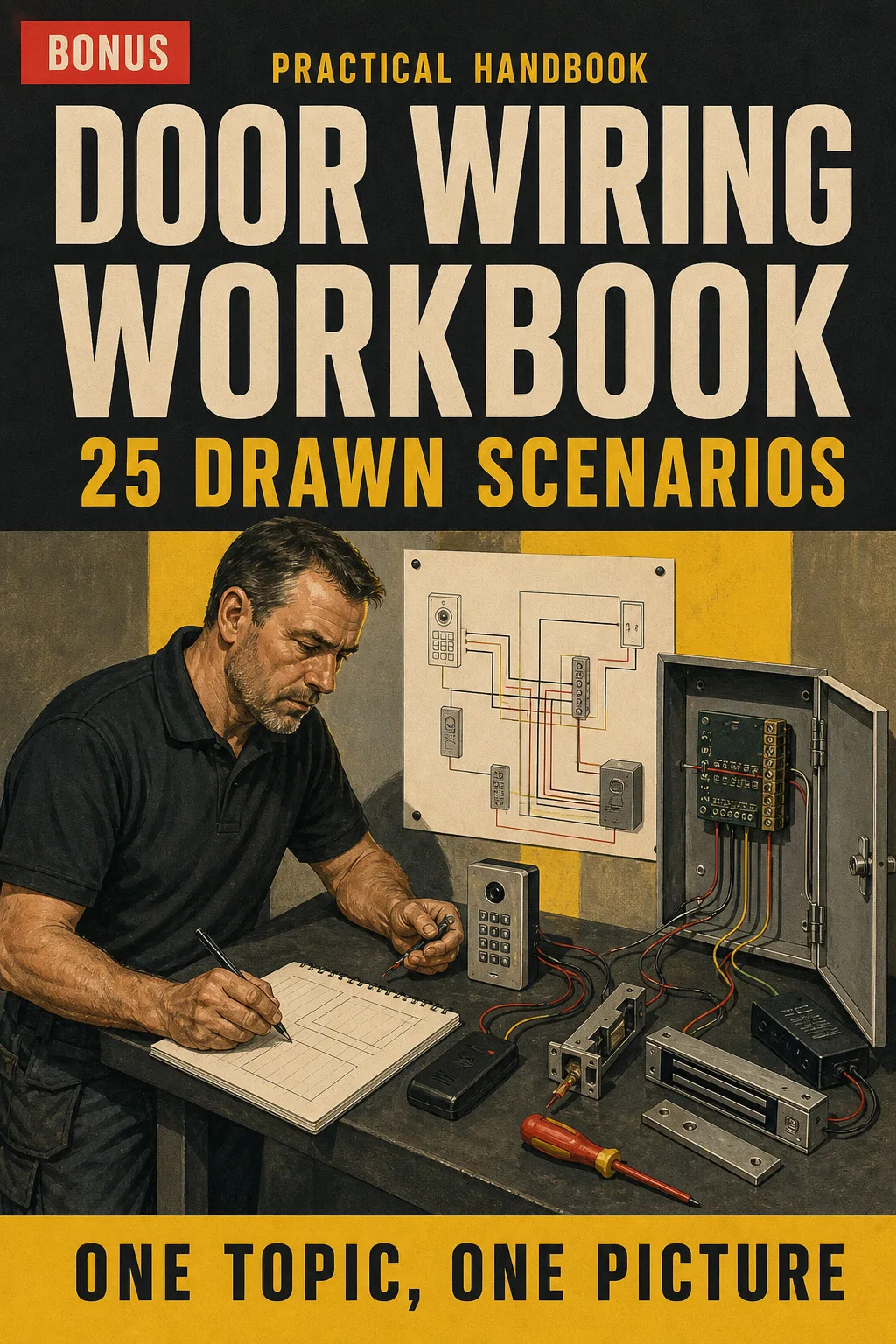
Door Wiring Workbook: 25 Drawn Scenarios

BONUS 1: «Door Wiring Workbook: 25 Drawn Scenarios»

Value on its own: US$ 17.90

Practise on real-style doors: choose the lock, size the power supply and trace the wiring, then check your answer against the drawing.

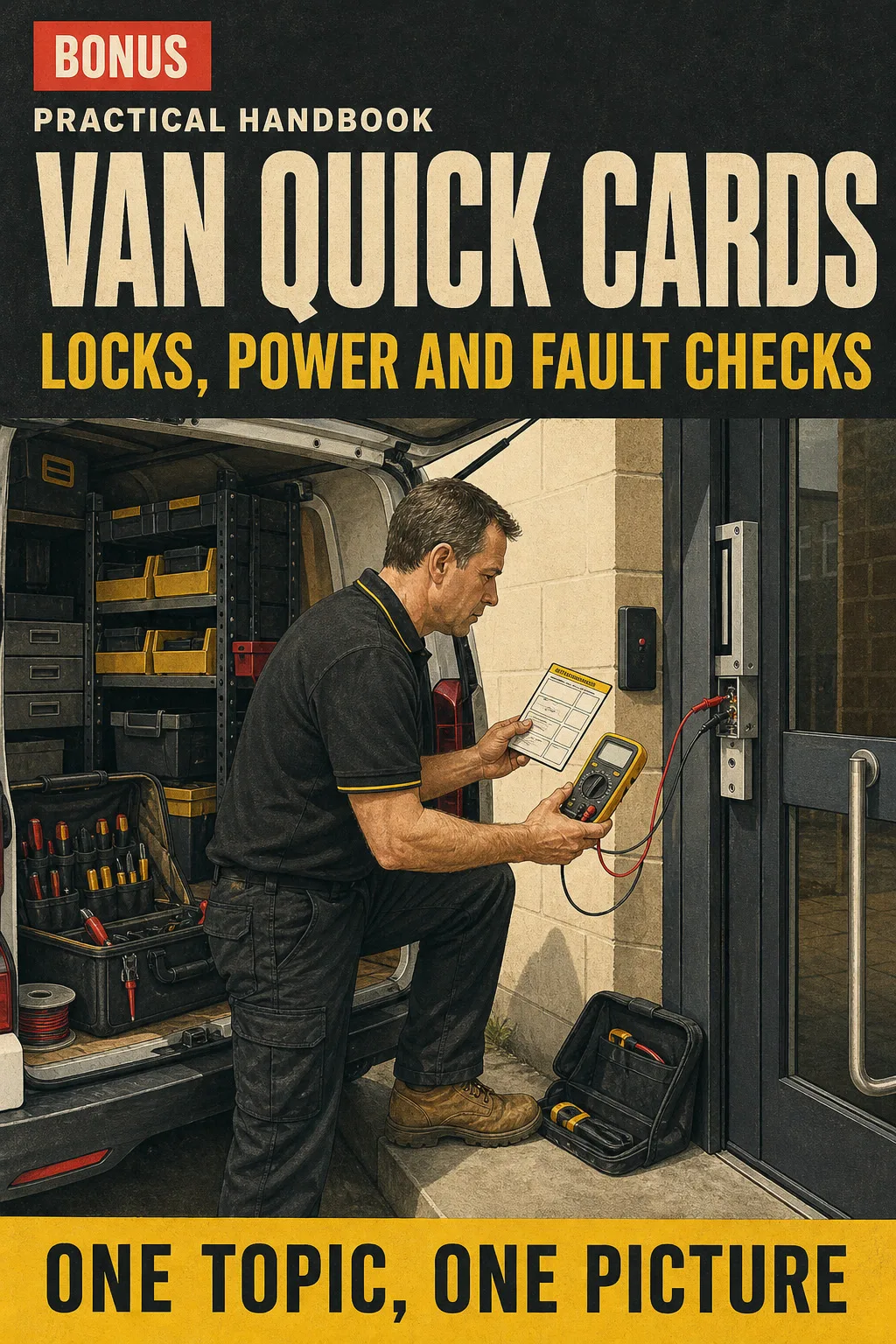
Van Quick Cards: Locks, Power and Fault Checks

BONUS 2: «Van Quick Cards: Locks, Power and Fault Checks»

Value on its own: US$ 14.90

Print them and keep them in the van: lock types, fail-safe vs fail-secure and the fault-check order, one card each, readable at a glance.

Door Entry & Access Control Illustrated with 2 Free Books

  • Door Entry & Access Control Illustrated: 68 illustrated pagesUS$ 63
  • BONUS 1: Door Wiring Workbook: 25 Drawn ScenariosUS$ 17.90
  • BONUS 2: Van Quick Cards: Locks, Power and Fault ChecksUS$ 14.90
  • High-resolution PDF to printIncluded
Total value US$ 95.80
YOUR PRICE:
US$ 27
You save US$ 68.80
YES, I WANT DOOR ENTRY & ACCESS CONTROL ILLUSTRATED FOR US$ 27

📄 This is a digital PDF book sent to your email: nothing is printed or shipped.

Secure purchaseEncrypted payment30-day guarantee

PDF by email: We email you Door Entry & Access Control Illustrated as a PDF, together with the two free books. It's a single payment: no installments, no extra charges.

Who This Book Is For

You're adding doors to your work

You're adding doors to your work

The whole system in order, from the block diagram to the lock, before you take on your first access job.

You've got a door job booked

You've got a door job booked

Survey, lock choice, PSU sizing and the wiring steps on the page, so you turn up knowing what to order and in which order to fit it.

You already fit and maintain doors

You already fit and maintain doors

The fault-finding order and the escape-route pages to hand for call-outs, printed and kept in the van.

Everything You Get Today

US$ 95.80US$ 27
YES, I WANT DOOR ENTRY & ACCESS CONTROL ILLUSTRATED FOR US$ 27

📄 This is a digital PDF book sent to your email: nothing is printed or shipped.

30DAYS
GUARANTEE

30-Day Guarantee

Try Door Entry & Access Control Illustrated for 30 days, bonus books included.

We refund everything if the file won't open, if the book isn't what you see here, if you were charged twice or if the email doesn't arrive. Just email us.

You pay once. No subscriptions.

Frequently Asked Questions

Is it for me if I'm already an electrician?

Yes. It assumes you know electrics and doesn't explain what a volt is. It puts the access side in order: locks, power, readers, wiring, escape rules and fault finding.

Where does the content come from?

It's checked against current UK guidance: BS 7671, BS 7273-4, BS EN 60839-11-1, BS EN 179, BS EN 1125 and BS EN 13637, and ICO guidance on UK GDPR. Fire and building rules follow the documents for England (Regulatory Reform (Fire Safety) Order 2005, Approved Documents B and M). Scotland, Wales and Northern Ireland have their own, so check them locally. It doesn't reproduce text or tables from any standard.

Is it official material?

No. It's an independent, brand-neutral illustrated guide, not linked to any manufacturer, standards body or trade scheme. Terminals are drawn generically (NO, NC, COM, 12 V and 24 V, D0/D1, OSDP A/B), so you can match them to any maker's schematic.

Does it replace training or the manufacturer's instructions?

No. It's a study and site reference, with no certificate or CPD hours. Always follow the kit's instructions. On escape routes and fire doors, the final design is set by the fire risk assessment and the person responsible for the building.

Are the practice scenarios from an exam?

No. The 25 scenarios in the workbook are written for this book. They aren't questions from any exam, course or certification.

When and how do I get it?

As a PDF by email, sent to the address you enter when you pay. The 2 free books come with it.

Do I have to pay every month?

No. It's a one-off payment.

Can I have it on paper?

Yes. It's a printable PDF: print the pages you need, or the whole book, and keep it in the van.

How does the refund work?

You have 30 days. We refund everything if the file won't open, if the book isn't what you see on this page, if you were charged twice or if the email doesn't arrive: just email us.

Before You Close This Page

No more rereading manuals that don't stick.

Fail-safe or fail-secure: you see it drawn and that's it.

You turn up on site knowing where everything goes.

Drawings make studying faster.

The book is right below.

One-time payment: US$ 27 · Guarantee: 30 days · PDF by email

YES, I WANT DOOR ENTRY & ACCESS CONTROL ILLUSTRATED FOR US$ 27

📄 This is a digital PDF book sent to your email: nothing is printed or shipped.